
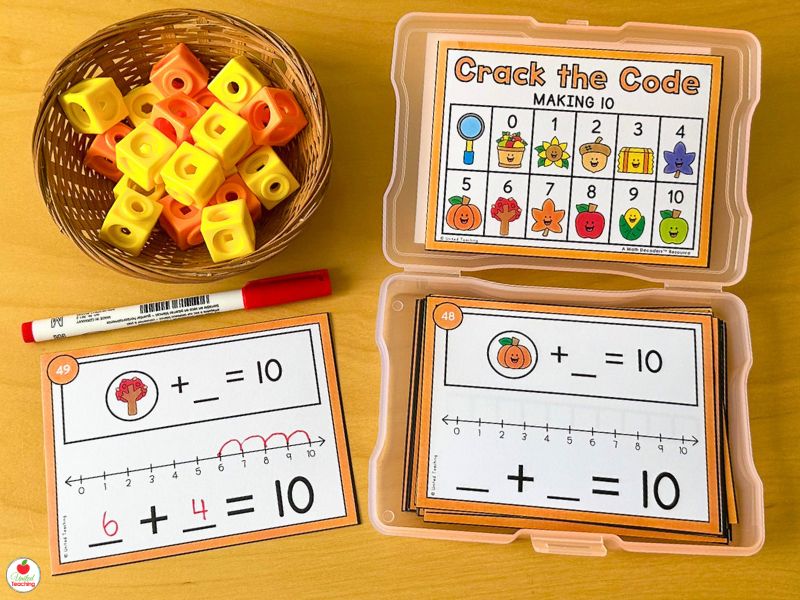
If you’ve ever watched a class light up the moment something feels like a “mystery”, you already know why crack-the-code activities work. They turn practice into purpose: students solve questions to unlock letters, symbols, or clues — and suddenly fluency feels like a game instead of a worksheet. Used well, these puzzles build automaticity in number facts, strengthen reasoning, and keep early finishers busy without drifting into busywork.
Here’re a some of the classroom-friendly practices to use codebreakers as a short, repeatable routine. It suits busy teachers who want practical, print-and-go activities and a system you can run across the term.
Why Codebreakers Build Fluency
Crack-the-code maths supports fluency because it adds three things standard drills often miss:
- Motivation: students want the answer so they can decode the message.
- Volume of practice: puzzles naturally include lots of short questions.
- Self-checking: if the message doesn’t make sense, students know to recheck.
For teachers looking for Maths resources for teachers, codebreakers are also easy to differentiate — you can keep the same format while changing the skill level underneath.
What A Good Crack-The-Code Puzzle Includes
Not all codebreakers are equal. The best ones have:
- A clear key (e.g., answers match letters, or a number-to-letter grid)
- Short, purposeful questions (facts practice, not long multi-step problems)
- A meaningful reveal (a silly joke, a classroom message, or a themed word)
- Just enough challenge to require thinking, not guessing
If you’re curating kindergarten teacher resources, start with picture-supported codes (numbers matching icons) and keep the “decode” message short — 4 to 6 letters are plenty.
A Simple 10-Minute Routine You Can Run All Year
This works as a daily warm-up, a maths rotation, or an early finisher task.
1) Set the focus (1 minute)
Tell students the skill: “Today’s codebreaker is doubles to 10” or “addition within 20”.
2) Model two questions (2 minutes)
Do one example slowly, then one quickly. Show how to find the answer, then locate the matching letter.
3) Timed solve (5 minutes)
Students work independently (or in pairs). Encourage quiet checking rather than rushing.
4) Decode + reflect (2 minutes)
Students read the message. Ask: “Which questions slowed you down?” and “What strategy helped?”
This routine becomes even easier to sustain if you keep a small bank of printables from teacher resources Australia ready to go.
Skills That Work Particularly Well for Codebreakers
Codebreakers are strongest when the maths is short and repeatable. Great options include:
- subitising and counting collections (early years)
- number bonds to 10 and 20
- doubles and near doubles
- addition/subtraction within 20
- skip counting patterns (2s, 5s, 10s)
- times tables and related division facts (upper primary)
- place value (10 more / 10 less, expanded form)
A tip: pick one “fluency family” per fortnight (e.g., number bonds) so students build speed through repetition.
A Mini Lesson Structure (Easy to Drop into Your Planning)
If you like a consistent format, here’s a repeatable flow you can add to a lesson plan for teachers template.
Learning intention: We can solve number problems efficiently and use answers to decode a message.
Success criteria: I can solve the questions accurately and explain a strategy I used.
- Warm-up (5–10 mins): Crack-the-code puzzle (target skill).
- Teach (5 mins): Demonstrate one strategy (e.g., make ten, doubles, count on).
- Guided practice (10 mins): Small group reattempt on 6–8 selected questions.
- Independent (10 mins): Second puzzle or a matching activity for the same skill.
- Exit check (2 mins): One quick question + “What strategy did you use?”
Differentiation Without Running Three Different Lessons
You can keep the same puzzle format and adjust the maths underneath.
- Support: fewer questions, smaller number range, visual supports (ten frames, number lines).
- Core: full puzzle with the target skill (e.g., within 20).
- Extend: mixed operations, missing addends, or “two-step” decode where students solve then sort answers.
This is where best teacher resources really help — reusable templates mean you can swap the numbers but keep the structure familiar.
How to Keep It “Maths-Rich” (And Not Just A Code Game)
To make sure the learning sticks, add one short talk move:
- “How did you solve that quickly?”
- “Show me a different strategy.”
- “Which ones are doubles? Which ones are make-ten?”
- “Which answers do you know instantly now?”
Even 60 seconds of discussion shifts the activity from “puzzle time” to real strategy building.
Quick Assessment Ideas
Crack-the-code activities can double as assessment if you watch for patterns:
- Which questions are consistently wrong?
- Are mistakes strategy-related (e.g., counting errors) or fact gaps?
- Who finishes fast but inaccurate (needs checking habits)?
- Who is accurate but slow (needs practice volume)?
A simple tracking grid (student names down the side, skills across the top) is enough to guide your next puzzle choice.
Making It Work in A Real Classroom
To keep the routine calm:
- Teach “check as you go” (circle tricky questions, don’t guess)
- Use pencils only (easy corrections)
- Let pairs decode together after solving independently
- Keep a “help card” on the table: number line, ten frame, or facts poster
When you browse teacher resources websites, look for codebreakers that include answer keys, clear instructions, and versions across levels so you can differentiate quickly.
Wrap-Up
Crack-the-code maths is one of those rare activities that feels fun and does the job: it builds fluency through repeated, purposeful practice. Run it as a short routine, keep the skill focus tight, and you’ll see students start to answer faster, check more carefully, and talk about strategies with more confidence.
About the Author